

21 Peer-To-Peer Property Lending Websites
You have dozens of choices when it comes to peer-to-peer property lending. As far as we know, we’re listing every single one of your choices on this page.
See 4thWay’s definition of peer-to-peer lending.
The majority of P2P property lending websites offer relatively high interest rates while typically looking at development lending and short-term property lending, called bridging lending. Borrowers are not receiving rent against these properties and everything else being equal you can be less confident about getting all your money back. Although the record of success across the industry has been exceptionally good, even through recession and a property-market fall.
A small number of P2P property lending providers offer lending that is usually intrinsically especially low risk. Typically, this means lending to borrowers against properties that are receiving rent or very robust protections against losses.
That can mean homeowner mortgages and loans (although those are very rare in P2P), mortgages to buy-to-let landlords, and also mortgages to owners of commercial properties, such as tenanted shops or care homes.
Just two P2P property lending providers in the UK focus largely on those kinds of lending. (Proplend and Housemartin. Skip to Proplend’s entry, below. | Skip to Housemartin’s entry.)
Regardless of the type of lending, a good proportion of peer-to-peer property lending companies contain the risks using top-quality loan approval processes, by requiring valuable property security from the borrowers, through reserve funds set aside to cover expected losses and by reacting rapidly and appropriately to borrowers in difficulty.
What the peer-to-peer property lending platforms have in common
Normally you’re first in the queue to get your money back if a borrower is unable to repay, and the P2P lending company needs to repossess and sell the property. In the list below, we will always make it clear when this is not the case.
(Sometimes you don’t want to be at the front of the queue, because being second or third means that you can earn much higher interest rates.)
Almost all property peer-to-peer lending platforms do either a) interest-only loans, where lenders get monthly interest paid to them by their borrowers and the money you lent is repaid to you at the end, or b) “bullet loans”, whereby you receive all the interest and your original loan at the end, with no payments in between.
Both of those types of loans – where you don’t receive steady repayments of the money you have lent – can potentially increase your risks, but it also makes it easier for you to keep your money out on loan and earning interest. And these risks are sometimes more than offset by fantastic property security, reserve funds and other aspects.
Not all peer-to-peer property lending companies are listed in 4thWay’s comparison tables with a review from one of our specialists, but we’re working on it.
Largely it depends on the companies providing over 100 facts, then answering our Q&As, then having gruelling interviews with us, then another Q&A with detailed data submissions from them, and finally background checks and other checks on our side. Not until then do they make it into our detailed comparison pages.
So here, on this page, we tell you about all of them available in 2026, including the ones that haven’t provided enough information for us to assess their risks and strengths.
The platforms that have passed our strict tests based on international banking standards – and therefore have been awarded 4thWay PLUS Ratings – are on top of the list. The rest are listed in order of size:
Proplend
Size, history and types of loans: Roughly £290 million of mortgages against rented residential and commercial properties since 2014. It also approves other loans, but very rarely.
Proplend’s 4thWay PLUS Rating:

Based on Proplend’s tranche A loans where the properties are receiving rent.
Lender losses: Just two loans, limited tranches B and C, have lost some money through Proplend*, so that lenders have easily made massive profits overall.
Most similar to: like the peer-to-peer property lending company Housemartin, the majority of loans are secured against property that is receiving rent, and like CapitalStackers and Relendex in terms of stacked tranches that you can select for yourself:
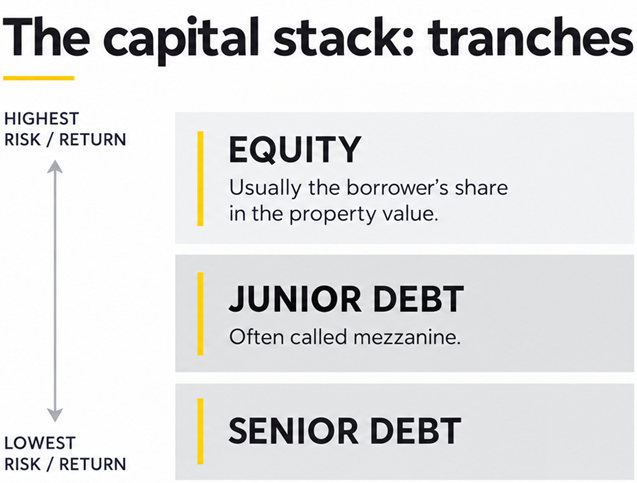
Average loan-to-value: Proplend splits its loans into tranches for lenders. If you lend in tranche A of a loan then you have a maximum loan-to-value of 50%, which is incredibly low.
If you lend through tranche B then you sit above tranche A lenders in the stack, where the loan-to-value is a maximum 65%.
Here’s an example for tranche B. Say the property is repossessed and sold for a loss of 40% against the property valuation at the time the loan was approved. That means it’s sold for 60% of the valuation. In tranche B, you were lending the cut between 50% and 65% of the valuation. You will now lose the part between 60% and 65%, getting back only the part you were lending between 50% and 60%. So you lose one-third of the amount you lent.
If you lend through tranche C, then you take the slice above B’s 65%, but still have a maximum of 75% LTV. Still highly respectable for rental properties, but as you would guess, “junior” debt like this significantly adds to your risks.
If you want, you can blend your lending by taking part in more than one tranche of the same loan.
Average rents: Proplend typically ensures landlords’ rent will cover the mortgage payments with an additional 10% cover or more.
Other protections: Proplend takes three to six months’ interest in advance, effectively reducing the risk of losing money overall by a modest few percentage points.
Place in the queue: Your tranche tells you your place in the queue.
Transparency: Proplend is among the most transparent opportunities you’ll find when peer-to-peer lending in property in the UK. It shares most facts about its people, processes and data with 4thWay.
Interest rates: You’re looking at an average of 7.81%. These interest rates are after fees and expected losses.
Available in an IFISA.
Who chooses loans? You can choose your own loans and tranches.
Minimum you can lend: £1,000 per loan.
Early exit: You can exit early provided other lenders have the money to buy you out.
Visit Proplend* or read the Proplend Review by one of our specialists.
Somo
Size, history and types of loans: At least £475 million in property bridging loans completed since 2014.
Somo’s 4thWay PLUS Rating:
Lender losses: Up to October 2026, lenders have only suffered a negligible loss of interest to bad debts, but no losses to their loans. The team’s experience at Somo and prior stretches over two decades with 2,000 loans. They themselves have taken a hit on just four loans in that time.
Most similar to: CapitalRise, CrowdProperty, Folk2Folk, Invest & Fund and Kuflink, in that it does bridging lending, and you can choose your own loans with no reserve fund. (Somo has no option to auto-lend.) Similar to HNW Lending, Somo takes a first loss – in this case the first 10% on junior loans. (That means when you’re not first in the queue to get your money back if a loan turns bad.)
Average loan-to-value: 58.70%. The maximum is usually 70%. While some loans are for heavy refurbishments, Somo approves these as bridging loans and sets the maximum amount based on the initial valuation and not on the hoped-for post-refurbishment valuation of the property.
Other protections: None.
Place in the queue: You can be first, second or third to get your money back, behind high-street banks.
Transparency: Somo currently provides 4thWay substantial data, information and access to key people.
Interest rates: 8.96% after expected losses. No IFISA.
Who chooses loans? You choose which loans to lend in yourself.
Early exit: You can exit early provided other lenders have the money to buy you out.
Minimum you can lend: £5,000.
Visit Somo* or read the Somo Review by one of our specialists.
Housemartin
Size, history and types of loans: Housemartin has completed total lending of £35 million. That’s since it started in 2019.
This is certainly an odd one out in P2P lending in property in the UK, in that Housemartin effectively sets up multiple, bankruptcy-remote borrower companies itself, buys the properties and lets them out.
Each separate company houses one loan. Thus, Housemartin is not one borrower, with the risk of bad debts of one loan contaminating the other, but instead becomes multiple borrowers, with segregated risks.
You also benefit or take the hit of property-price changes, even though you’re legally a lender not a property owner. Technically, with it all being tied up using article 36H “P2P agreements”, this whole arrangement scrapes into our current definition of P2P lending.
Housemartin’s 4thWay PLUS Rating:
Lender losses: There have been some losses on four loans, although on three of them the earnings on those loans outweighed those small losses. On the one loan with an overall loss, it was self-imposed by lenders, because they decided to sell at a small loss in order to lend for a better return in another loan.
Most similar to: no other P2P lending company does loans like this. In addition, when lending, you decide whether to pay the asking price or bid at a different price, which is also unusual. As with BLEND, CapitalRise, Kuflink, Invest & Fund, Somo and Sourced Capital, you can choose your own loans. As with all the mentioned competitors, there’s no reserve fund.
Other protections: None.
Place in the queue: You’re always first in the queue to recover your money if a loan goes bad and the property has to be repossessed and sold. Rather, there are some very minor cases where you might end up not quite being first, but those should be rare.
Transparency: Housemartin has provided a huge amount of data and access to 4thWay. Information on its public website is good, although it should say more about its key people. Signed-in lenders get a lot of useful information.
Interest rates: Housemartin is now paying 7.31%, with the possibility of a capital gain (or loss) when the property is sold. Available in an IFISA.
Who chooses loans? You choose your own loans.
Early exit: No.
Minimum you can lend: £1
Visit Housemartin* or read the Housemartin Review by one of our specialists.
HNW Lending
Size, history and types of loans: Around £163 million, mostly in peer-to-peer property lending, especially bridging loans, since 2014.
It’s also one of the rare P2P lending sites to do loans to homeowners – albeit rarely. Plus, it does some loans secured against other assets, such as performance cars.
HNW Lending’s 4thWay PLUS Rating:
Lender losses: Less than 1% of the total lent has ever been written off through HNW Lending*. Total losses are also very low compared to interest earned.
Most similar to: Somo and Invest & Fund, in that it does peer-to-peer property bridging loans with no reserve fund, although you can instead choose to auto-spread your money with a reserve fund. Similar to Somo, HNW Lending takes a first loss – in this case 10%.
Average loan-to-value: Senior loans have an incredibly low 44% average LTV. The maximum is sensible for these loans at 70% and maximum 65% for junior loans.
The good LTVs are necessary to recover bad debts, because, while hardly any loans have been written off, a huge amount of loans go late or get classed as having gone bad. This is normal for these kinds of loans, but special to HNW Lending is that it can take longer to recover the full loan amount on some of its loans and can present additional difficulties.
Other protections: HNW Lending’s directors take the first loss of 10%, in the event that repossessing and selling the property doesn’t recover all the money.
In the broader scheme of things, the first loss will have little impact on lenders’ average returns. However, that directors have lent six and even seven figures in the same loans as individual lenders is highly reassuring.
Those using auto-lend also have a fund with a cash surplus to protect them. While 4thWay only gets information and data on that surplus irregularly, the recent update shows it is more than sufficient to cover any and all likely write-offs in the near future.
Place in the queue: You can be first or second in the queue to recover your money if a loan goes bad and the landlord has other debts.
Transparency: HNW Lending is transparent with 4thWay, sharing facts about its people and processes, and lots of data and access to people.
Interest rates: 6%-12% after fees. Available in an IFISA.
Who chooses loans? If you want, HNW Lending will auto-spread your money with the aim of at least 15 loans (and the spread was considerably more last time we checked). Or you choose your own loans. HNW Lending quite often has extraordinary deals, paying close to 10% interest on less than 40% LTV.
Minimum you can lend: £10,000. This is per loan when choosing your own loans but spread across at least 15 loans – usually more – when using auto-lend. This minimum falls to £5,000 through its IFISA.
Early exit: Yes, you can sell your loans online through the HNW Lending website, provided other lenders want to buy you out.
Visit HNW Lending* or read the HNW Lending Review by one of our specialists.
CapitalRise
Size, history and types of loans: £460 million since it started in 2016. It offers bridging loans and development loans, focusing on prime central London, and increasingly prime developments in both outer London and wealthier parts of the Home Counties.
Restrictions: Only for investors earning £100,000 or with £250,000 in assets (excluding own home), or for professional investors, or investors who have recently invested in one unlisted company (e.g. through crowdfunding websites).
CapitalRise’s 4thWay PLUS Rating:
Lender losses: Negligible losses at CapitalRise*.
Most similar to: As with BLEND, CrowdProperty, Kuflink, Invest & Fund and Somo – which all offer bridging and development only – you can choose your own loans. As with all the mentioned competitors, there’s no reserve fund.
Average loan-to-value: 67% on non-development property loans. For development loans, the average amount lent in the first tranche released to developers versus the starting property price is typically 65%-70%. Looking at the total loan facility versus the future hoped-for sale price, the average is 63%.
Other protections: None.
Place in the queue: You can be first in the queue or later, depending on the individual lending opportunity.
Transparency: CapitalRise has provided a huge amount of information about itself to 4thWay and provides regular data feeds, showing the results of its entire loan book. It’s one of the most transparent peer-to-peer property lending companies.
(Note that CapitalRise would technically describe itself as providers of other investments, not P2P lending. For 4thWay’s definition of P2P lending see here.)
Interest rates: 9.44%, before losses. Available in an IFISA.
Who chooses loans? You choose your own loans.
Minimum you can lend: £1,000.
Early exit: You can exit early provided other lenders want to buy you out for the value of the loan. The charge for leaving is 1.5%.
Visit CapitalRise* or read the CapitalRise Review by one of our specialists.
Loanpad
Size, history and types of loans: £550 million lent, exclusively on peer-to-peer property lending, specifically property development (renovations and refurbishments rather than ground-up builds) and bridging loans, since 2018.
Loanpad’s 4thWay PLUS Rating:
Lender losses: No lender losses and no losses are likely.
Most similar to: BLEND and CrowdProperty, in that it just does senior bridging and development loans. “Senior” means no other lenders (such as banks) can get their money back before you do if the borrower is unable to repay, and the property needs to be repossessed and sold.
As with BLEND and CrowdProperty, you also spread your money across more than one bridging and development loan automatically. Indeed, at Loanpad, your money is always automatically spread across all live peer-to-peer property loans and redistributed on a daily basis. This is unique across all P2P property lending sites.
As with all the mentioned competitors, there’s no reserve fund. All Loanpad loans are similar to Proplend’s tranche A loans in that the most you ever lend is capped very low. In this case, it’s a maximum of 56% of the property valuation.
Average loan-to-value: 48.7% and 31.6% based on the hoped-for sale price of the completed development. (Those aren’t mis-prints. The ratios really are that good.)
Other protections: None, but partner lending businesses lend in a different loan to all the same borrowers for the same purpose. Their loan is about 25%-33% of the size of the Loanpad loan. Their lending is in a junior position, so they will lose their money before you do.
Place in the queue: You’re always first in the queue to recover your money if a loan goes bad, ahead of other lenders.
Transparency: Loanpad is one of the most transparent and accessible peer-to-peer property lending sites, providing 4thWay with all the information and data we ask for and more.
Interest rates: 5.1%-5.9% before losses, with zero or negligible expected losses. Available in an IFISA.
Who chooses loans? You choose your own loans.
Early exit: You can exit early provided other lenders want to buy you out. There’s no charge for selling in its account paying the lower interest rate. To exit its higher-paying account you either have to wait 60 days or pay 0.5%.
Minimum you can lend: £0.01
Visit Loanpad* or read the Loanpad Review by one of our specialists.
CapitalStackers
Size, history and types of loans: £47 million since it started in 2014. It offers P2P lending in property secured against residential or commercial developments.
CapitalStackers’ 4thWay PLUS Rating:
Lender losses: CapitalStackers* lenders lost money on some loans that were issued during the recent macroeconomic troubles for property developers. Most diversified lenders still are in the plus: total interest paid to lenders has been four times write-offs.
Most similar to: CrowdProperty in terms of being largely focused on development lending. Crowdstacker in that it does very junior lending (called mezzanine), where banks or others lend a lot more money first that is due to be repaid before you in the event the debt turns bad. Proplend and Relendex in terms of stacked tranches that you can select for yourself:
CapitalStackers splits your junior lending into as many as five tranches, each with increasingly higher rates as the risk rises.
Average loan-to-value: CapitalStackers generally goes to the limit of 75% versus the hoped-for sale price. Only the wealthiest and perhaps more experienced lenders, including CapitalStackers’ own directors, are allowed to lend at the highest tranches of risk.
Average rents: No rent, as loans are almost always developments.
Other protections: None, although the directors and close family do around 1/4 of the lending through the same online lending platform as you.
Place in the queue: Usually second, third, fourth, fifth or even sixth in the queue. Your tranche – your place in the “stack” generally tells you your place in the queue.
Transparency: CapitalStackers has provided a huge amount of information about itself to 4thWay – a lot more than we asked for. And gives us highly detailed data on a regular basis. It’s about the most transparent of the peer-to-peer property lending companies.
Interest rates: The average interest rate has been 13.49%. Available in an IFISA.
Who chooses loans? You choose your own loans and tranches.
Minimum you can lend: £2,500.
Early exit: You can exit early provided other lenders want to buy you out and agree the price: you could sell your loan parts to them for more or less than you paid. Indeed, you can make massive profits selling loans for more than you paid. (Read The Safest 20% Returns In P2P Lending.)
Visit CapitalStackers* or read the CapitalStackers Review by one of our specialists.
FOLK2FOLK
Size, history and types of loans: £828 million to borrowers that can be any businesses with real property (real estate or land) to back the loans. Its peer-to-peer property lending also includes loans specifically about the properties itself, such as property developments and bridging loans.
FOLK2FOLK’s 4thWay PLUS Rating: Unrated. FOLK2FOLK is not awarded a PLUS Rating because it does not provide enough information to assess the riskiness of its loans.
Lender losses: FOLK2FOLK lenders have suffered minimal losses so far (although limited information suggests a few more might finally happen in the nearish future).
Most similar to: Like CrowdProperty, CapitalRise, Somo and Kuflink, it also does bridging and development lending, and you can choose your own loans. But it is more or less alone in approving a lot of property-secured loans to other businesses that are not in the property sector and that are not for short-term needs.
Average loan-to-value: No information. However, the maximum loan-to-value, is usually 60%, which is excellent.
Other protections: None.
Place in the queue: First, except in exceptional circumstances.
Transparency: While FOLK2FOLK provides too little information for us to fully assess the risks, it does still provide some level of transparency to us.
Interest rates: In the region of 8.50%. Available in an IFISA.
Who chooses loans? You choose which loans to lend in.
Early exit: You can sell loans for the same price you paid, provided there are lenders who want to buy the loan parts from you. You’re charged £250. You have to pay that fee regardless of whether you successfully sell.
Minimum you can lend: £20,000 per loan!
Visit FOLK2FOLK or read the FOLK2FOLK Review by one of our specialists.
easyMoney
Size, history and types of loans: £714 million since 2018, although we don’t know how much of that total was through easyMoney’s online P2P lending portal and how much was other lending. It mostly does development loans and it also does some short-term (bridging) loans.
easyMoney’s 4thWay PLUS Rating: Unrated. easyMoney doesn’t provide sufficient information for a rating.
Lender losses: We think there have been no losses, but information is sparse. We think that some losses might have been covered by easyMoney to maintain a zero-loss record.
Most similar to: It’s like Kuflink, Invest & Fund and Somo, in that it exclusively does bridging and development lending in both senior loans or junior loans. As with Invest & Fund, lending is automated as standard with no reserve fund, while certain classes of lender can self-select loans. In easyMoney’s case, that means professional investors.
It’s now unclear whether easyMoney automatically diversifies your money from the beginning. We knew that previously your initial deposit mmight all have landed in one loan. With details desperately scarce, and easyMoney just mentioning that your money is spread across “several” loans, we don’t know if this has changed or how many loans is now the minimum. We know that easyMoney does however try to increase your diversification over time.
Average loan-to-value: The average LTV is just 53.40% on bridging loans, and 60.00% of the hoped-for sale price on development loans. We have no information about how this differs across each of easyMoney’s lending accounts.
The maximum loan-to-value is 75% for non-development loans, which is the most we would ideally want to see. It has a maximum of 70% of the hoped-for sale value on development loans.
Average rents: Not applicable.
Other protections: None.
Place in the queue: First or later.
Transparency: easyMoney provides nothing like enough information either publicly or to 4thWay for lenders to assess the risks. For example, easyMoney provides no information or data about how many loans have been extended, and for how long. That information is necessary to attempt to establish whether bad debts are being kicked down the road to cause problems later.
There’s insufficient information to assess whether lenders for its various accounts are getting a good deal, i.e. a sensible, fair interest rate.
Interest rates: easyMoney is advertising target lending rates from 5.40% for regular lenders to 7.30% or more for professional lenders. Available in an IFISA.
Who chooses loans? You lend automatically, although professional investors lending £1 million can choose their own loans. It’s not clear whether, or how much, they can cherry pick the best loans.
Early exit: You can exit early provided other lenders want to buy you out. You’ll receive less back if the latest interest rates are higher than the ones that you agreed to lend at, in order to compensate the new lender.
Minimum you can lend: £100.
Invest & Fund
Size, history and types of loans: Invest & Fund has done £611 million in bridging and development loans since 2015.
Invest & Fund’s 4thWay PLUS Rating: not rated.
Lender losses: No losses to lenders that we know of.
Most similar to: As with BLEND, CapitalRise, CrowdProperty, Kuflink and Somo – which all offer bridging and development only – you can choose your own loans – although only if you’re a wealthy or sophisticated investor. As with BLEND, CrowdProperty, HNW Lending and Loanpad, you can also spread your money across more than one loan automatically. As with most of those competitors, there’s no reserve fund.
Average loan-to-value: No data on this one.
Other protections: None.
Place in the queue: Usually first, except Invest & Fund occasionally offers second or third charge if lenders already have the first-charge loan.
Transparency: Invest & Fund does not provide data to 4thWay needed for risk analysis and rarely responds to our queries. Public information on its website for individual lenders can get out-of-date.
Interest rates: Invest & Fund states that latest rates have been 6.75% after fees.
Borrowing and lending rates have come down a few percentage points over the past few years, which is normal and expected when a P2P lending company proves its ability and grows in size.
Who chooses loans? You choose your own loans.
Early exit: You can exit early provided other lenders want to buy you out. You can’t lower the price when selling loan parts to speed up a sale or increase the price to sell for an additional profit. You’re charged 0.25% of the loan value when you sell.
Minimum you can lend: The minimum initial contribution is £2,500. The minimum you can lend in a single loan is £250 (or £25 when buying existing loan parts off other lenders).
Visit Invest & Fund or read the Invest & Fund Review by one of our specialists.
CrowdProperty
Size, history and types of loans: £465 million exclusively on peer-to-peer property lending, specifically property development and bridging loans, since 2014.
CrowdProperty’s 4thWay PLUS Rating: not rated.
Lender losses: CrowdProperty lenders have increasingly faced write offs during 2025 and 2026, and more is likely to come. We know that, by spring 2026, 3% of the total ever lent had been written off as losses for lenders. CrowdProperty currently doesn’t provide 4thWay with up-to-date data that we have permission to analyse in this way. We can give you no timely figures.
Most similar to: BLEND and Loanpad in that it just does senior bridging and development loans. “Senior” means no other lenders (such as banks) can get their money back before you do if the borrower is unable to repay, and the property needs to be repossessed and sold. As with BLEND, CapitalRise, Kuflink, Invest & Fund and Somo – which all offer bridging and development only – you can choose your own loans. But, as with BLEND and Loanpad, you can also spread your money across more than one bridging and development loan automatically. As with all the mentioned competitors, there’s no reserve fund.
Average loan-to-value: CrowdProperty doesn’t provide us with this data any more.
Other protections: None.
Place in the queue: You’re always first in the queue to recover your money if a loan goes bad, the developer has other debts to pay, and the property has to be repossessed and sold.
Transparency: CrowdProperty does not provide data to 4thWay needed for risk analysis.
Interest rates: 5.00% (very rough estimate) before losses. Available in an IFISA.
Who chooses loans? If you want, CrowdProperty will auto-lend your money and you can set up the maximum amount that can be applied to any one tranche of a loan (although you might still end up lending in multiple tranches against the same development as those tranches are raised by the borrower). Or you choose your own loans.
Early exit: No.
Minimum you can lend: £500, which can be split automatically across at least ten loans. If you lend more than £500, your money can potentially be split across many more loans
Visit CrowdProperty or read the CrowdProperty Review by one of our specialists.
Kuflink
Note that, as of autumn 2026, Kuflink has been putting new prospective lenders on a waiting list for over a year.
Size, history and types of loans: £447 million as of September 2026 in peer-to-peer property bridge lending and property development lending. That’s since 2016.
Kuflink’s 4thWay PLUS Rating: not rated.
Lender losses: Unknown.
Most similar to: As with BLEND, CapitalRise, CrowdProperty, Invest & Fund and Somo – which all offer bridging and development only – you can choose your own loans. As with all the mentioned competitors, there’s no reserve fund.
Average loan-to-value: Kuflink no longer provides data.
Average rents: Not applicable.
Other protections: None.
Place in the queue: First, second or third.
Transparency: Kuflink no longer provides access or data to 4thWay and last we checked it had removed important information on its site, such as its “Investor losses to date”.
Interest rates: Perhaps typically up to about 10% in individual loans – before losses. Available in an IFISA.
Who chooses loans? You choose which loans to lend in.
Early exit: You can exit early provided other lenders want to buy you out and agree the price: you could sell your loan parts to them for more or less than you paid.
Minimum you can lend: £1,000, and then in £500 increments after that.
Visit Kuflink or read the Kuflink Review by one of our specialists.
Relendex
Size, history and types of loans: £218 million exclusively on property peer-to-peer lending, specifically in residential buy-to-let, rented commercial properties and property development loans, since late 2013.
Relendex’s 4thWay PLUS Rating: Unrated. Relendex doesn’t provide enough information for a rating.
Lender losses: There have been some very minor confirmed losses for lenders.
Most similar to: It’s similar to CapitalStackers for the variety of property loan types that it does. It’s also similar to CapitalStackers and Relendex in terms of stacked tranches that you can select for yourself:
Average loan-to-value: the LTV on non-development loans is around 54.70%, which is fantastic. On development sites, the loan size compared to the initial property site valuation, or against the hoped-for future sale price, is unknown.
Average rents: No information supplied.
Other protections: None.
Place in the queue: You are usually first in the queue, sometimes second, and sometimes a mix.
Transparency: Relendex initially provided huge amount of information about itself to 4thWay, although it does not provide a detailed, monthly breakdown showing the history of all its loans, and has not updated us for many years.
Its web statistics and information for lenders has some use, but is not complete enough. Relendex is therefore substantially below average on transparency compared to other peer-to-peer property lending companies.
Interest rates: 7.86%, including an estimated deduction by 4thWay based on losses so far, but this estimate is very rough due to limited data. Available in an IFISA.
Who chooses loans? You choose which loans to lend in yourself.
Early exit: Yes, if you can find another lender to buy your loan parts for the same price you paid.
Minimum you can lend: £5,000.
BLEND
Size, history and types of loans: £114 million since 2017 in peer-to-peer property lending. Its focus is entirely on development loans and short-term (bridging) loans.
BLEND’s 4thWay PLUS Rating: Unrated. BLEND doesn’t provide sufficient information to be rated.
Lender losses: There have been no confirmed lender losses so far.
Most similar to: CrowdProperty and Loanpad, in that it just does senior bridging and development loans. “Senior” means no other lenders (such as banks) can get their money back before you do if the borrower is unable to repay, and the property needs to be repossessed and sold.
As with CapitalRise, CrowdProperty, Kuflink, Invest & Fund and Somo – which all offer bridging and development only – you can choose your own loans. But, as with CrowdProperty and Loanpad, you can also spread your money across more than one bridging and development loan automatically. As with all the mentioned competitors, there’s no reserve fund.
Average loan-to-value: BLEND does very few bridging loans, but it allows up to 75% LTV. We have no up-to-date information on average LTVs, as we receive no data from it. The maximum it accepts is 75% of the expected development sale price.
Average rents: Not applicable.
Other protections: None.
Place in the queue: Always first.
Transparency: BLEND initially provided a lot amount of information about itself to 4thWay, but it’s not kept up with regular data submissions.
Interest rates: Estimated 8.44% after allowing for potential losses in normal times of about 1% of loans.
Who chooses loans? You choose which loans to lend in or you can lend automatically.
Early exit: You can exit early provided other lenders want to buy you out and agree the price: you could sell your loan parts to them for more or less than you paid. The cost is 0.6% of the loan parts you sell.
Minimum you can lend: £1,000.
Visit BLEND or read the BLEND Review by one of our specialists.
Sourced Capital
Size, history and types of loans: Sourced Capital last updated its publicly available data on 31st December 2025, showing total lent of £58 million since it started in 2019. It’s the only UK-based P2P property lending company to focus exclusively on development lending with no bridging or other lending thrown in.
Sourced Capital’s 4thWay PLUS Rating: Unrated. Sourced Capital doesn’t provide 4thWay with sufficient information for a rating.
Lender losses: As far as we know, there have been no lender losses so far, but we receive no data.
Most similar to: BLEND, CrowdProperty and Loanpad in that it just does senior loans. Sourced Capital is unique in that it exclusively does development loans. As with BLEND, CapitalRise, Kuflink, Invest & Fund and Somo (which all offer bridging and development) you can choose your own loans. As with all the mentioned competitors, there’s no reserve fund.
Average loan-to-value: We don’t have the latest figures on the average loan sizes versus the starting or current property valuation. The maximum borrowers can borrow to begin with is 70% of the starting value of the property. The maximum borrowers can borrow altogether to complete the development is 70% of the hoped-for sale price.
Other protections: None.
Place in the queue: You’re always first in the queue to recover your money if a loan goes bad, the developer has other debts to pay, and the property has to be repossessed and sold.
Transparency: Sourced Capital does not provide data to 4thWay and we have no or limited access to their key people.
Sourced Capital has improved its public information for prospective lenders recently, although not all questions are answered.
Interest rates: Sourced Capital typically pays lenders 10% to 12% before losses. Available in an IFISA.
Who chooses loans? You choose your own loans.
Early exit: No.
Minimum you can lend: £1,000 per loan
Visit Sourced Capital or read the Sourced Capital Review by one of our specialists.
Nester
Size, history and types of loans: Nester states it has done £52 million in property loans. These are mostly bridging and development, we believe, although it might also have approved some buy-to-let lending.
Nester’s 4thWay PLUS Rating: Unrated. Nester is not awarded a PLUS Rating because it has not provided enough information to be listed.
Lender losses: Nester states that lenders have suffered no losses.
Most similar to: As with BLEND, CapitalRise, CrowdProperty, Kuflink, Invest & Fund and Somo – which offer bridging and development lending – you can choose your own loans. As with all the mentioned competitors, there’s no reserve fund.
Average loan-to-value: Our estimate of the average amount lent versus the property size is 49.50%.
Other protections: None.
Place in the queue: Always first.
Transparency: Nester provides no information or data to 4thWay, and we haven’t yet been granted substantial access to its key people. It provides negligible useful information to the public for the purposes of assessing it as an investment opportunity.
Interest rates: We have no data on this. We know only that rates average less than 9%.
Who chooses loans? You choose your own loans.
Minimum you can lend: £1,000 per loan, including in its IFISA.
Early exit: You can exit early provided other lenders want to buy you out.
JustUs
Size, history and types of loans: £48 million since 2013, the vast majority of which is peer-to-peer property lending.
JustUs does all sorts of loans, including personal loans, but its property loans include bridging loans and development loans. It has also done buy-to-let mortgages, but it seems that these are now very few and far between.
Unlike most P2P lending in property, you sometimes receive some of your actual loan money back in the monthly repayments (as opposed to getting your money back at the end).
JustUs’ 4thWay PLUS Rating: Unrated. JustUs is not awarded a PLUS Rating because it has not provided enough information to be listed.
Lender losses: None on JustUs’ property loans.
Most similar to: JustUs is like BLEND, CrowdProperty and Loanpad, in that you can spread your money across more than one bridging and development loan automatically. But, as with BLEND, CapitalRise, CrowdProperty, Kuflink, Invest & Fund and Somo – which all offer bridging and development only – you can also choose your own loans. As with all the mentioned competitors, there’s no reserve fund on its property lending (although there is one for your unsecured lending).
JustUs has some auto-lending options. Those options enable a set up rather like BLEND, CrowdProperty and Loanpad, in that you can limit your property lending to senior bridging and development loans. “Senior” means no other lenders (such as banks) can get their money back before you do if the borrower is unable to repay, and the property needs to be repossessed and sold.
Average loan-to-value: Unknown, although this appears to have risen a fair bit recently. We have seen one loan for nearly 90% of the property’s valuation, although 85% appears to be its more usual maximum. Loans within 10 percentage points of 70% LTV are common.
Other protections: None on property lending.
Place in the queue: First or second.
Transparency: JustUs provides 4thWay with insufficient information to assess its risks, so it’s below average on transparency compared to other peer-to-peer property lending companies. Its own website information and statistics for its website users are sort of reasonable.
Interest rates: 8.64% after losses on all loans, not just property.
Who chooses loans? You choose your own loans or you can lend automatically.
Minimum you can lend: £10, or £100 initial contribution for the JustUs IFISA. (The minimum amount you can transfer in directly from another ISA is £1,000.)
Early exit: You can exit early provided other lenders want to buy you out and agree the price: you could sell your loan parts to them for more or less than you paid. At present, this market to sell your loan parts is being redeveloped, so you need to get in touch with JustUs to try to sell your loans.
LandlordInvest
Size, history and types of loans: £20 million in property peer-to-peer lending, specifically in property bridging loans, some buy-to-let and a little property-development lending. While it started in 2017, it stopped all lending in mid-2024, and only restarted in again in autumn 2026.
LandlordInvest’s 4thWay PLUS Rating: Unrated. LandlordInvest doesn’t yet provide enough information for a rating.
Lender losses: Up to July 2026, lenders have lost money on three loans out of nearly 100.
Most similar to: Relendex, in that it does bridging lending, BTL lending and property-development lending, and you can choose your own loans with no reserve fund. (LandlordInvest has no option to auto-lend.)
Average loan-to-value: it’s best to await new information on this, since LandlordInvest has just restarted under new management.
Average rents: No information supplied.
Other protections: None.
Place in the queue: You are first or second in the queue.
Transparency: LandlordInvest’s new management has stated it is going to be extremely transparent and so we await further details.
Its web statistics and information for lenders previously had some value, but less so now that it is beginning again until it is clear what is remaining the same and what has changed.
Interest rates: Its first loans since relaunch have been 10%-15%, but this could easily come down as it approves more loans. Available in an IFISA.
Who chooses loans? You choose which loans to lend in yourself.
Early exit: Yes, if you can find another lender to buy your loan parts. You may attempt to sell for as much as 20% more or for as little as 20% less than the par value of the loan. There’s a 0.5% fee on the sale amount.
Minimum you can lend: £100 (although it’s unclear if this has changed since re-launch).
Crowdstacker
Size, history and types of loans: Since 2021, Crowdstacker now focuses exclusively on property development lending, having switched from business lending.
It’s completed about £15 million in development lending. (Previously it did around £70 million in business lending.)
Crowdstacker’s 4thWay PLUS Rating: Unrated. Crowdstacker doesn’t provide sufficient information.
Lender losses: In its first five years it had a couple of years of absolutely horrendous overall results, although that was all business lending. It hasn’t yet officially confirmed any losses on property lending, although a lot of older development lending is now very late.
Most similar to: CapitalStackers in that it does junior development lending where banks or others lend a lot more money first that is due to be repaid before you in the event the debt turns bad.
Average loan-to-value: We don’t have any figures.
Other protections: None.
Place in the queue: On projects I’ve seen, you and your fellow P2P lenders are not usually first in the queue to recover your money if a loan goes bad, the developer has other debts to pay, and the property has to be repossessed and sold. At least one other lender, such as a bank, takes priority.
Transparency: Crowdstacker increased the information on its public website in the past, but it’s still not sufficient. It doesn’t engage with 4thWay to provide detailed data, information and interviews of key people.
Interest rates: While you might get 13%-17% before bad debts, we have no figures on expectations after all the very late loans finally come to a conclusion. Available in an IFISA.
Who chooses loans? You choose your own loans.
Early exit: No.
Minimum you can lend: Typically £100, but it varies with each loan.
Simple Crowdfunding
Size, history and types of loans: Simple Crowdfunding has historically offered other investments rather than lending through its website. Up to around mid-2025, it had completed over £10 million in non-lending projects. However, since then it has also funded perhaps £3.6 million in P2P loans that were mostly for property development. It will consider lending against any type of property.
Simple Crowdfunding’s 4thWay PLUS Rating: Unrated. Simple Crowdfunding doesn’t provide sufficient information.
Lender losses: We know as of June 2025 there had been no losses, but we have no up-to-date data on this.
Most similar to: BLEND, CrowdProperty and Loanpad in that it just does senior loans. Sourced Capital is unique in that it exclusively does development loans. As with BLEND, CapitalRise, Kuflink, Invest & Fund and Somo (which all offer bridging and development) you can choose your own loans. As with all the mentioned competitors, there’s no reserve fund.
Average loan-to-value: We don’t have any figures.
Other protections: None.
Place in the queue: Unusually, not all loans appear to be secured against the properties. Where you do benefit from secured lending, I’ve only seen projects so far where you’re first in the queue to recover your money if a loan goes bad, the developer has other debts to pay, and the property has to be repossessed and sold.
Transparency: Simple Crowdfunding currently provides 4thWay with no access or data and the information on the public section of its website is extremely thin and it’s unclear what periods they cover or when they are updated. It’s one of the least transparent peer-to-peer property lending companies.
Interest rates: Most interest rates appear to be in the 8% to 12% range, before losses. Available in an IFISA.
Who chooses loans? You choose your own loans.
Early exit: No.
Minimum you can lend: £100 per loan perhaps, although Simple Crowdfunding can set higher limits on individual offers.
CARLTON Bonds (formerly MAVEN)
Size, history and types of loans: CARLTON Bonds started in 2019, but it doesn’t provide any information to 4thWay or the public on how much lending has gone through it.
When you lend through CARLTON Bonds, you lend to property developers to develop properties for sale. The properties could be residential or commercial.
It’s not certain at this stage whether CARLTON Bonds is peer-to-peer property lending, due to lack of information.
Restrictions: Only for a) investors earning £100,000 or with £250,000 in assets (excluding own home), or b) for professional investors, or c) investors who have recently invested in one unlisted company (e.g. through crowdfunding websites). A few others can invest too, e.g. if you’ve been the director of a company with revenue of £1 million or more in the past two years.
CARLTON Bonds’ 4thWay PLUS Rating: Unrated. CARLTON Bonds doesn’t provide sufficient information for a rating and might not have sufficient history.
Lender losses: Not enough information.
Most similar to: Kuflink, in that it mostly does senior loans. As with BLEND, CapitalRise, Kuflink, Invest & Fund, Somo and Sourced Capital (which all offer bridging and development) you can choose your own loans. As with all the mentioned competitors, there’s no reserve fund. And similar to CapitalRise, in that who is allowed to invest is very limited.
Average loan-to-value: We don’t have any figures.
Other protections: None.
Place in the queue: You’re usually first in the queue to recover your money if a loan goes bad, the developer has other debts to pay, and the property has to be repossessed and sold.
Transparency: CARLTON Bonds hasn’t gone through an intensive 4thWay assessment and doesn’t provide us with data. CARLTON Bonds’ website doesn’t contain any useful data for the public.
Interest rates: 5%-10% before losses. Available in an IFISA.
Who chooses loans? You choose your own loans.
Early exit: No.
Minimum you can lend: £1,000 per loan.
Removed from the list
Assetz Capital is winding down its P2P operations starting in December 2022, because it’s shifted how it raises funds for loans to a new model.
CP Capital, which started in 2020, effectively closed in 2024, with no new loans originated since then. (It was part of CrowdProperty, which continues for now.)
crowdahouse closed down, relaunched and apparently closed down again. It now accepts lending again, but only if the lender is a business, not an individual. Last we checked (November 2021), Crowdahouse did not have a secure website, include at the point of logging in. This is extremely concerning.
Crowdestates, the Mayfair-based business that is not to be confused with the Estonia-based Crowdestate (with no “s”). Seemingly no new lending for years.
CrowdLords is winding down gently, giving the tighter regulations as the reason.
Downing Crowd last approved a loan in September 2025 as it gently shifts business model.
fruitful soft-closed its doors to P2P lending in autumn 2015 to shift to more ordinary, non-P2P mortgage lending, so the company was removed from this list. As of end November 2015, lenders had already received 75%-85% of their money back and were still earning interest on the remainder.
Funding Circle announced in April 2017 that it will no longer be doing peer-to-peer property lending. (It later then closed all its P2P operations to focus on funding small business loans another way in March 2022.)
FundingKnight has not offered new loans for a long time.
FundingSecure is a peer-to-peer property lending company that went into administration in October 2019.
FutureBricks left the pure P2P lending model in 2021. It was unclear to us for a few years whether it still fit within our broader definition. Considering lack of data, bouncing email addresses and the site being down in April 2025, we consider it unlikely to be live in a model that fits on this page, so have taken it down.
houseFundr was due to open in 2015, but never did. It was going to focus on property development loans in London.
Landbay stopped doing peer-to-peer property lending on 5th December 2019. It now only allows financial institutions to fund loans through it.
LendInvest has stopped allowing small individual lenders to lend through it, and there was always a question mark anyway about whether it was truly “P2P” lending.
Lendy has gone out of business.
MoneyThing closed and went into an orderly wind down in December 2019. (In December 2020, due to borrower litigation, MoneyThing could not afford to continue as it was, and it went into administration.)
Octopus Choice permanently stopped doing property peer-to-peer lending in February 2021 and is winding down gently.
PropertyCrowd stopped doing P2P lending during the COVID-19 outbreak and is no longer available to individual lenders.
RateSetter, which mostly did personal loans but did a lot of property peer-to-peer lending too, has been sold to Metro Bank and its operations will now be taken over for bank lending instead of P2P lending.
Shojin chose to go into a controlled administration in March 2026.
The House Crowd went into administration in February 2021.
ThinCats stopped doing peer-to-peer property lending in December 2019. It now only allows financial institutions to fund loans through it.
Wellesley & Co. stopped offering peer-to-peer lending in property in the UK three years after it offered its first P2P loan. (Some years after that, it went bust.)
Independent opinion: 4thWay will help you to identify your options and narrow down your choices. We suggest what you could do, but we won't tell you what to do or where to lend; the decision is yours. We are responsible for the accuracy and quality of the information we provide, but not for any decision you make based on it. The material is for general information and education purposes only.
We are not financial, legal or tax advisors, which means that we don't offer advice or recommendations based on your circumstances and goals.
The opinions expressed are those of the author(s) and not held by 4thWay. 4thWay is not regulated by ESMA or the FCA. All the specialists and researchers who conduct research and write articles for 4thWay are subject to 4thWay's Editorial Code of Practice. For more, please see 4thWay's terms and conditions.
The 4thWay® PLUS Ratings are calculations developed by professional risk modellers (someone who models risks for the banks), experienced investors and a debt specialist from one of the major consultancy firms. They measure the interest you earn against the risk of suffering losses from borrowers being unable to repay their loans in scenarios up to a serious recession and a major property crash. The ratings assume you spread your money across hundreds or thousands of loans, and continue lending until all your loans are repaid. They assume you lend across 6-12 rated P2P lending accounts or IFISAs, and measure your overall performance across all of them, not against individual performances.
The 4thWay PLUS Ratings are calculated using objective criteria that can be measured and improved on over time, although no rating system is perfect. Read more about the 4thWay® PLUS Ratings.
*Commission, fees and impartial research: our service is free to you. 4thWay shows dozens of P2P lending accounts in our accurate comparison tables and we add new ones as they make it through our listing process. We receive compensation from CapitalRise, CapitalStackers, Housemartin, Loanpad, Proplend and Somo, and other P2P lending companies not mentioned above either when you click through from our website and open accounts with them, or when you make an investment, or to cover the costs of conducting our calculated stress tests and ratings assessments. We vigorously ensure that this doesn't affect our editorial independence. Read How we earn money fairly with your help.